- News Ambassadors
- Posts
- How mobile clinics are bringing healthcare to Chicago’s streets
How mobile clinics are bringing healthcare to Chicago’s streets
Through collaborations with trusted on-the-ground partners, medical school teams are filling treatment gaps for unsheltered Chicagoans by meeting them where they are

Shia Levitt
January 09, 2026
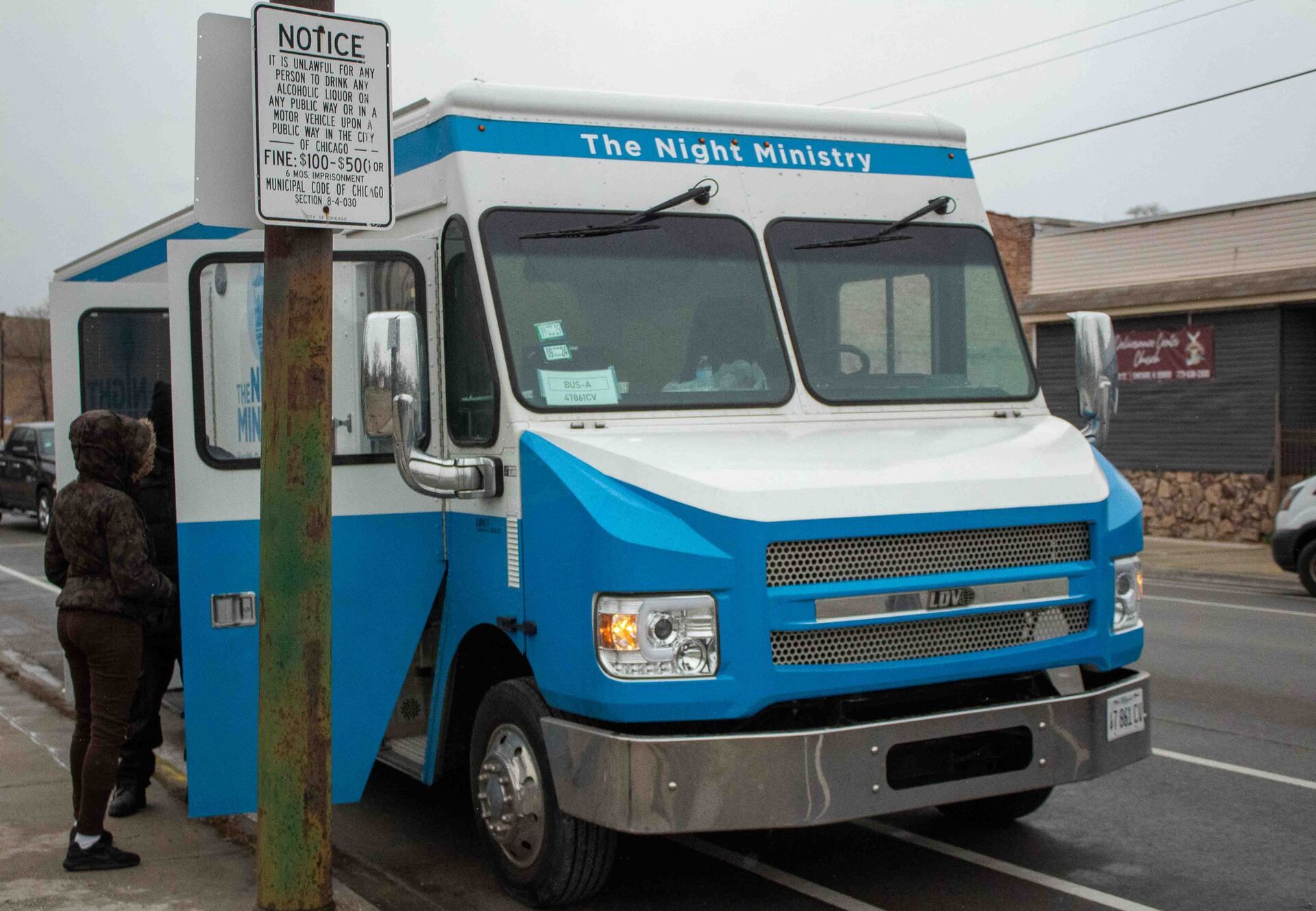
The Night Clinic’s Mobile Health Clinic provides a bagged lunch and mobile medical care to those experiencing poverty and homelessness in the neighborhood. (📸: Maizie Hummel-Logee)
Happy New Year and welcome to your favorite newsletter! 👏🏼👏🏽👏🏿 We’re excited to catch you up on the News Ambassadors program and highlight the amazing work done by our partners. If you care about strengthening communities and better supporting democracy, help us by following us on Instagram or Linkedin, donating or forwarding this newsletter to a friend.
Was this forwarded to you? Subscribe here to get future updates directly to your inbox.
📰 One big story 📰
This month, we’re highlighting a story on mobile health clinics reaching Chicagoans on the street, sometimes layering in services to meet other needs beyond health. Chicago’s medical students, residents, doctors and volunteers run mobile community medical clinics that help fill a healthcare access gap for residents who lack stable housing and provide experiential learning for aspiring medical professionals.
The story was co-written by two student reporters in Columbia College of Chicago’s 2025 News Ambassadors cohort, part of a rigorous reporting class taught by Solutions Journalism trainer (and now full-time Solutions Journalism Network staffer) Sharon Bloyd-Peshkin. Bloyd-Peshkin’s students regularly report and publish stories in numerous outlets, including this solutions story for StreetWise Magazine.

The Night Ministry staffer Javonna Askew (right) works with a client at a tent encampment. (📸: Lloyd DeGrane for The Night Ministry)
Why we like it: Reporters Maizie Hummel-Logee and Eleanor Lusciatti provide scope and scale to help us understand why some patients are reluctant to navigate “brick and mortar healthcare” even when facing urgent treatment needs, and why it makes a difference when medical professionals can meet them where they are.
As we read their story about community-responsive teams, partnerships on the ground, and students playing a major role in filling coverage gaps, we saw parallels to the work some of our partner newsrooms do as they strive to bring their communities news that is helpful and relevant to their lives and the challenges they face. Like these health teams, newsrooms are also trying to integrate local knowledge, foster partnerships, and show up day after day to build trust and produce journalism that is truly responsive to their community’s needs. It also reminded us that communication needs to be a two-way street so newsrooms can keep up with communities’ shifting priorities and information needs amidst changing circumstances.
Broader context: A variety of other fields beyond journalism are using community engagement strategies to better understand and meet the unique needs of local communities. Healthcare workers adapt their strategies to meet the continually changing circumstances and locations of the people they serve, just like newsrooms need two-way channels of communication to allow them to better adapt priorities to a community’s shifting needs — especially in the midst of shifting political landscapes, climate challenges and safety concerns during times of social and political upheaval.
Read to the full story in StreetWise Magazine (on pages 8-12). StreetWise is a magazine sold by people who are homeless or low-income as an alternative to panhandling. It’s one of nearly 100 members of the International Network of Street Papers headquartered in Scotland.
Tip : When covering communities or individuals who are responding to local challenges, consider leveling up your reporting by integrating Trabian Shorters’ concept of asset-framing™ into your solutions journalism story to help tell fuller, more accurate stories of the people and communities impacted.
📣 We want to hear from you! 📣
In 2026, News Ambassadors is exploring possibly hosting a 90-minute Depolarization Reporting Strategies training, focused on the Complicating the Narratives method. We normally do these trainings for journalism schools, newsrooms and fellowship cohorts, but this one would be open to individuals like you — students, professors or newsrooms or other storytellers, with a pay-what-you can donation request for participants. Originally created for reporters covering contentious issues, these tools have wide applications for leveling up reporting and storytelling on many other topics as well as for public policy, education, governance and other fields beyond journalism.
Our question: If you might be interested in attending a remote training, what parameters/ logistics/timing should we consider as we explore putting this on the calendar? Let us know! [email protected]
- Shia
News Ambassadors ✨Resource Spotlight✨
We’ve got a couple cool resources for newsrooms and community journalism folks that caught our attention this month, so let’s dive in!
Libraries & Local Newsrooms Working together: Resources for Collaborations
Our collaborating newsrooms in Missouri, Illinois, Georgia and elsewhere have worked with local libraries on community engagement work and beyond. We’ve heard about a few resources for libraries working with newsrooms and News Ambassadors created one ourselves — Tips for Libraries Working on Engagement (h/t to Kristine Villanueva!). So we were thrilled to hear about these Resources for Collaborations with local newsrooms originating from the library side, put together by a group called Library Futures.
Slide for your SoJo slide deck!
Sometimes folks who are new to SoJo can get it confused with feel-good fluff or activist journalism until they better understand the rigorous, evidence-based four pillars of SoJo that differentiate it from these imposters. We recently rediscovered this slide from Solutions Journalism Network which helps people differentiate Solutions Journalism from imposters like advocacy journalism.

📆 Upcoming Events/Opportunities 📆
We've got several leads for you this month, including journalism job leads and opportunities for journalists, students and recent grads as well as some leads for newsrooms and engagement teams.
Looking for a job in journalism? Check out the January Journalism jobs from Rebecca Aguilar’s Calling All Journalists list!
Guide to Journalism conferences in 2026
Are you ready to make plans for 2026? Check out this overview of the many Journalism conferences already planned for 2026.
Two Solutions Journalism Trainings and Opportunities:
Solutions Journalism Network has upcoming FREE monthly Intro to Solutions Journalism trainings in January and one in February. Both welcome journalists, educators, high school teachers, and students! Check it out as an intro or a refresher to Solutions Journalism. (We learn something new at each training we attend!) January 13, 2026, 9 AM-10 AM ET/12-1 PM PT and February 3, 2026, 6pm-7pm ET/ 9-10 PM PT/
»Register HERE for January 13 training«
»Register HERE for February 3 training«
Innovation Fund for Solutions Journalism About Government
Are you doing solutions journalism about the government? Apply for funding to support your work from the Solutions Journalism Network (SJN). This innovation fund is part of the Advancing Democracy Initiative, a partnership with Hearken and Trusting News. The fund is open to U.S.-based newsrooms that have produced solutions journalism in the past.
Scripps Howard Journalism Fund and Institute for Nonprofit News are offering 25 PAID journalism internships this summer for college students (undergraduate and graduate) as well as students graduating college in the 2025-26 school year! »Register to attend their January 22 Q & A Session HERE«
»Learn more and apply HERE by January 31, 2026«
Student journalists are also invited to attend a resume writing workshop on January, 14, 2026. »Register HERE«
Common Ground Journalism Fellowship for undergraduate or graduate students Common Ground USA has launched Common Ground Journalism Fellowship, in partnership with The Fulcrum, to support students reporting in contentious times.
» Apply HERE by January 15, 2026«
The 2026 International Radio and Television Society Foundation Summer Fellowship Program Application is NOW OPEN! Ready to take the next step?
»Apply HERE by January 15, 2026 « 🌟
Adjacent resources for community engagement/dialogue
The Constructive Dialogue Institute (CDI) has spent years studying what works. Drawing on rigorous research, program evaluation data, and lessons from partnerships with institutions across the country, CDI's research team has identified the essential factors that create a campus culture in which dialogue can thrive — even across deep differences. These Five Pillars of a Culture of Inquiry and Dialogue offer a practical framework for institutional leaders ready to strengthen their campus culture and reaffirm higher education's role as a champion of constructive dialogue and democratic values. Jan 27, 2026 3:00 PM - 4:00 PM ET » Register HERE «
Join 101 Substack
We’ve mentioned before how much we love Join or Die, the Netflix movie about how club involvement -from bowling league to garden club to church choir - is one of the strongest indicators of a healthy local democracy. So we’re excited to spread the word that our friends at Join or Die now have a substack! Join 101 Substack is live now and will be followed by a website coming in early 2026 at Join101.org. Check it out!
News Ambassadors now offers a la carte Depolarization Reporting Strategies trainings and coaching newsrooms, journalism schools and fellowship cohorts
We have accredited trainers on two methods: 1) Solutions Journalism and 2) Depolarization in Reporting Strategies centered on Complicating the Narratives, designed by High Conflict author/journalist Amanda Ripley and her Good Conflict colleague Hélène Biandudi Hofer. The strategies were born from researching conflict mediation psychology studies — how people actually behave when they're feeling suspicious and threatened by the other side — and distilling lessons journalists can use to improve coverage of contentious issues. Originally designed for reporters, these tools have applications for many different types of reporting and storytelling as well as far beyond the journalism field.
Interested in bringing a depolarization training to your organization or classroom? Fill out our Training Interest Form!
Among our recent past trainees: KBIA’s Culture Desk, Report for America, Public Media Journalists Association, Temple University, Prairie View A & M University, UNICEF media and many more.
📖 What we are reading 📖
If you haven’t checked it out already, spend some time with Press Forward’s Local News 2035 Scenarios summary chart. It highlights three scenarios describing the future of Local News.
We’re feeling pretty aligned with the third scenario at the moment, but would love to hear your thoughts of what future you’re envisioning or working to support!
That’s all we have for you this month, folks. We’ll see you next time!